


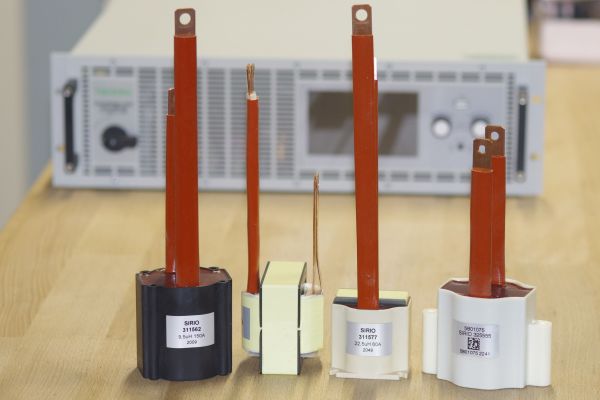
In industrial applications, it is often necessary to use dedicated inductors, as each application requires well-defined characteristics.
For this reason, Sirio has chosen not to offer a line of standard inductors, preferring instead to design special components, leveraging available production technologies and standard raw materials, normally available in stock. This allows us to provide a high-quality product, made to customer specifications, at the cost of a standard component.
The term “inductor” refers to a broad category of components with very different uses and applications, but which all have in common the function of “energy tank” in various high-frequency topologies.
If we consider the filtering stage of a high-frequency DC/DC converter, the output inductor is continuously swapping energy with the output capacitor.
The function of the inductor is to limit the variation in the converter’s output current; through the inductor’s winding a predominantly direct current flows, with a ripple superimposed at the switching frequency, or double that frequency depending on the topology.
Similarly, if we consider the Power Factor Corrector (PFC) stage of a converter, the inductor and capacitor exchange energy at the switching frequency, but in this case, the current flowing through the inductor has a main component at the mains frequency and a ripple superimposed at the switching frequency of the PFC stage.
More generally, in non-isolated conversion topologies (Buck, Boost, Buck-Boost), the current waveform varies substantially depending on whether operation mode is continuous or discontinuous.

Choice of the magnetic core
The function of the magnetic core in an inductor is to provide a preferential path for the magnetic flux induced by the current flowing through the winding, thus allowing energy to be stored in a non-magnetic, low-permeability region.
The choice of magnetic material to use for an inductor is primarily based on the following parameters: operating frequency, current waveform, maximum dimensions, and environmental conditions. The choice of magnetic core is crucial because it is closely linked to all other construction specifications: the number of turns and the conductor type, the insulation solution, and the output connectors.
There are various magnetic cores available on the market, distinguished by their chemical composition, manufacturing process, and dimensions. These factors determine their salient characteristics, particularly the behaviour of the core when frequency, flux density and temperature vary.